FSD010: Concept, overall scope definition, and market requirements
Title |
FSD010: Concept |
Current version |
V1 |
Products |
Safety Simplifier |
Requirements |
61508-1 clause 7.2 (concept), and clause 7.3 (overall scope definition) |
Purpose |
Define the concept, overall scope, and market requirements for the Safety Simplifier |
Input |
All relevant information necessary to understand the concept. |
Output |
FSD010: Concept, overall scope definition, and market requirements |
Table of contents
Concept
Safety Simplifier is a safety PLC (Programmable Logic Controller). It is intended to be used as part of an EUC (Equipment Under Control) as a logic subsystem, and is used to control, start, and stop machines and other equipment in a safe way.
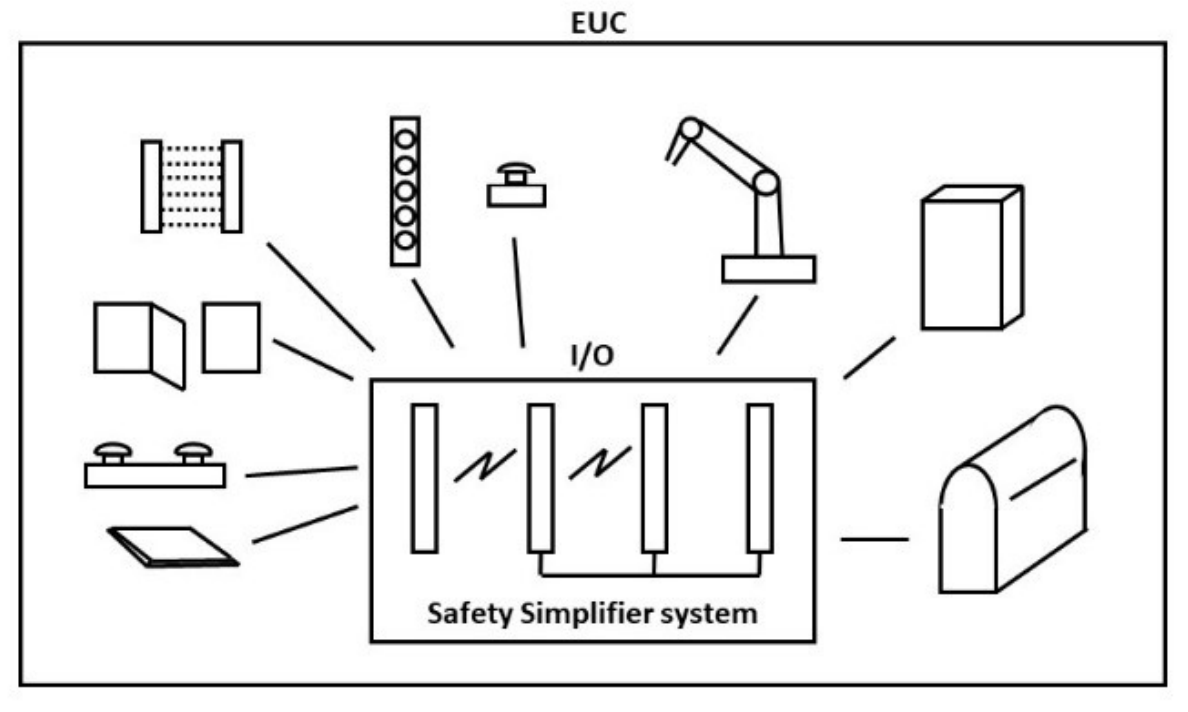
Safety Simplifier is intended to be used in applications which require safety integrity levels up to SIL3, PLe, Cat. 4. Examples of such applications include (but not limited to):
robots and robot cells,
cranes, hoists, and lifting equipment,
autonomous vehicles such as warehouse robots (i.e., not road vehicles),
injection moulding machines,
packaging machines
Safety Simplifier has:
Power supply compatible with 7V-33VDC input voltage,
0-14 programmable safety I/Os, useable redundantly,
2x2 safety relay outputs (two pairs of two relays, each pair can be used redundantly as a single safety output),
2.4 GHz radio (802.15.4) communication with other Safety Simplifiers,
CAN communication with other Safety Simplifiers,
General black channel interface to other Safety Simplifiers,
USB, radio and CAN configuration interfaces, for changing configurations and updating firmware.
IP65 housing,
4 M12 openings for contacts/cable glands,
Optional openings for E-stop, push buttons, and other elements in the front,
Optional LED front panel for status information,
Power supply
To be able to use Safety Simplifier in many different applications, it allows a wide input voltage range of 7V-33VDC. This allows it to be used in applications with different standard voltage levels, such as 12V and 24V.
Safety I/Os and relay outputs
Safety Simplifier has 0-14 programmable safety transistor I/Os, which can be used redundantly. These I/Os can be used to connect to safety sensors, safety switches, safety mats, safety light curtains, etc. Two redundant relay outputs are available, each is a pair of relays. Each relay output can be connected with the relays in paralell, or in series.
Radio communication
The safety radio communication protocol allows Safety Simplifiers to communicate with each other in a network, to share safety data. The protocol allows nodes in a network to repeat information from other nodes, for faster reaction times, increased reliability, and longer range.
CAN communication
Safety Simplifier can communicate with other Safety Simplifiers over CAN, both as a plug and play replacement for the radio communication, and as a communication link to other Simplifier units and networks. Two physical CAN interfaces are available which can be used for either of these purposes.
General black channel interface
The general black channel interface allows Safety Simplifiers to communicate over a general black channel, which can be used over any communication medium. This protocol allows a node to communicate with up to 4 other units (in the same or different networks).
Configuration interfaces
To simplify the configuration process of Safety Simplifier, it allows configuration over USB, radio, and CAN. These interfaces can be used to change configurations, update firmware, and read status information. Since Safety Simplifier can be used as a network of nodes, and since nodes often are installed in hard to reach places, the radio configuration interface is especially important for ease of use, as it allows a user to configure a network of Safety Simplifiers without needing to physically connect to each node.
Configuration tool
The Safety Simplifier configuration tool (Simplifier Manager) is a PC software tool used to:
Configure Safety Simplifiers,
Update firmware,
Monitor the status of Safety Simplifier systems.
Service and replacement of units
To simplify the service and replacement of Safety Simplifier units, an optional memory card can be installed in each unit, which can be used to store configuration data. When a unit is replaced, the memory card can be moved to the new unit, which, after an acknowledgement procedure by the user, will use the configuration data from the memory card.
Overall scope definition
Safety Simplifier is intended to be used as part of an EUC as a logic subsystem.
The scope of the risks and hazards analysis is limited to the functions in Safety Simplifier, and the interfaces between Safety Simplifier and the EUC. This includes:
safety I/Os and relay outputs,
communication between Safety Simplifiers,
power supply,
the environment that the Safety Simplifier may used in (e.g. temperature, humidity, vibration, EMC, etc.),
housing,
configuration interfaces,
user interfaces.
The hazard and risk analysis is in FSD011: Hazard and risk analysis.
Market requirements
The Safety Simplifier shall implement part (as logic subsystem) of one or several overall safety function(s) operating on an EUC within scope of the Machinery Directive 2006/42/EC and assigned/associated with a safety integrity requirement up to SIL 3 (IEC 61508) and/or PLe / CAT 4 (ISO 13849-1). |
The element safety function of the Safety simplifier shall provide output signals in accordance to a user defined algorithm/configuration in combination with the signals on its inputs, up to SIL 3/PL e. Note This is commonly referred to as a Safety PLC (Programmable Logic Controller). |
Safety Simplifier shall have an optional memory card for storing configuration data, which can be used to replace a unit without needing to reconfigure it (by transferring the memory card to a new unit and performing an acknowledgement procedure). |
Safety Simplifier shall have optional redundant potential free outputs. |
Safety Simplifier shall have (optional) digital safety IOs that can be used as:
The combo-IO shall be able to read the state of an input (usually a push button), and output an indication signal (usually for lighting an LED) on the same IO. |
Safety Simplifier shall have a radio communication interface for communication with other Safety Simplifiers. |
Safety Simplifier shall have a CAN communication interface for communication with other Safety Simplifiers in the same network (as a “plug and play” replacement or backup for the radio communication). |
Safety Simplifier shall implement the SimpleCAN communication protocol for communication with other Safety Simplifier networks, and Simplifier Gateway. |
Safety Simplifier shall be able to operate in temperatures between -20 to +65 degrees Celsius, and in humidity of up to 95%. Safety Simplifier shall be able to be stored in temperatures between -30 to +70 degrees Celsius, and in humidity of up to 95%. |